Best Sunscreen for
Acne-Prone Skin
in India — The Complete 2026 SPF Guide
Using the wrong sunscreen makes acne worse. Using no sunscreen makes post-acne marks permanent. This guide explains exactly what acne-prone Indian skin needs from SPF — and why non-comedogenic, broad-spectrum protection is the most underutilised acne treatment available today.
Why Sunscreen Is Non-Negotiable for Acne-Prone Skin — and Why Most People Get It Wrong
If there is one step that dermatologists universally agree is the most neglected and the most consequential in an acne management routine, it is sunscreen. Not the exfoliating acid. Not the retinoid. Not the vitamin C serum. Sunscreen. The product that a significant proportion of acne-prone Indian adults actively avoid — because they believe, incorrectly, that it clogs their pores and makes their skin worse.
The belief is understandable. Many people with acne have tried sunscreens and found their skin breaking out more, becoming shinier, and feeling worse for the experience. That reaction is real. But it is not caused by sunscreen as a category — it is caused by the specific formulas they were using: products built on heavy emollients, pore-blocking silicones, and occlusive bases designed for dry, sun-damaged skin rather than for oily, acne-prone complexions. The Indian sunscreen market has historically skewed toward these heavier formulas because the dominant marketing narrative centred on fair skin tone preservation rather than acne management. The result is a generation of acne-prone Indian consumers who gave up on sunscreen after a bad experience with the wrong product — and whose post-acne marks deepened progressively as a consequence.
Post-inflammatory hyperpigmentation — the flat, dark marks left after acne heals — is the most common skincare complaint among Indian adults. Across medium-to-deep Indian skin tones, the melanocytes that produce skin colour are highly reactive to both inflammation from the acne lesion itself and UV radiation from India's extreme sun. Without consistent SPF 50 protection, every acne mark on every Indian face is being actively darkened each morning — and every brightening serum, vitamin C drop, and exfoliation treatment applied in the evening is fighting a losing battle against hours of UV-driven melanin stimulation.
The stakes are not trivial. Post-inflammatory hyperpigmentation that could fade in three to six months with consistent SPF protection instead persists for twelve to twenty-four months without it. This affects the confidence, social experience, and professional life of millions of Indian adults between fifteen and forty-five who are managing acne and its aftermath. A non-comedogenic SPF 50 sunscreen — one that does not trigger new breakouts, does not leave a grey cast on Indian skin tones, and does not create the greasy film that makes acne worse — is not a luxury add-on to an acne routine. It is the treatment the routine cannot function without.
This guide addresses the complete picture: why UV radiation specifically worsens acne outcomes beyond PIH; how to read a sunscreen ingredient list to confirm non-comedogenicity rather than trusting unregulated label claims; the specific texture and formula requirements for acne-prone skin in India's climate; a comprehensive skin type matching guide; a step-by-step application protocol that ensures the SPF on the label is the SPF actually received; and the myths — some of them deeply embedded in Indian skincare culture — that are actively preventing people with acne from using the product that would most meaningfully improve their skin's long-term outcome.
India's UV environment is not forgiving. The country sits between latitudes 8°N and 37°N — within the high UV band for the majority of its area — and experiences a UV Index of 10 to 12 for six to eight months of the year across most major population centres. Chennai routinely records UV Index readings above 11 by 10 AM. Mumbai's UV peaks occur even during the cloudy pre-monsoon months. Delhi's summer UV, combined with reflective urban surfaces, creates exposure levels that dermatologists in temperate climates would classify as requiring maximum protection. For acne-prone skin in any of these cities, daily SPF 50 is not overcautious — it is the minimum appropriate intervention.
The Science of UV Radiation, Acne, and Post-Inflammatory Hyperpigmentation
How UV Radiation Worsens Active Acne
UV radiation affects acne through two distinct mechanisms that compound each other. The first is immune suppression: UV radiation — particularly UVA — suppresses the skin's local immune response by depleting Langerhans cells, the immune sentinels embedded in the epidermis. These cells are part of the skin's defence against bacterial infection, including the C. acnes bacteria responsible for inflamed acne lesions. Repeated UV exposure progressively reduces this localised immune defence — this is counter to the popular belief that sun exposure "dries out" and improves acne. A temporary surface-drying effect comes at the cost of deeper immune suppression that worsens acne over time.
The second mechanism is sebum oxidation. UV radiation oxidises the squalene component of sebum — producing squalene peroxides that are directly comedogenic. Studies have established that UV-oxidised squalene is a more potent trigger of comedone formation than unoxidised sebum, meaning daily unprotected UV exposure actively increases the comedogenicity of the skin's own natural oil. This creates a feedback loop: UV exposure increases comedone formation, which creates conditions for more inflamed lesions, which creates more PIH marks.
The Melanin-Acne-UV Triangle
Indian skin's higher baseline melanin content provides some UV protection — approximately SPF 2 to 4 of intrinsic photoprotection — but simultaneously creates a melanin overproduction response to inflammation that makes PIH formation more rapid and more severe than in lighter skin tones. An acne lesion triggers an inflammatory cytokine cascade that stimulates surrounding melanocytes to produce melanin as a protective response. In higher-melanin skin types, this response is both stronger and more persistent — producing a darker, more widespread PIH mark that persists longer than the equivalent mark on lighter skin.
UV radiation then amplifies this at every stage: it deepens existing PIH by directly stimulating melanocytes in already-hyperpigmented areas; it extends PIH duration by repeatedly re-triggering melanocyte activity in marks that would otherwise be fading; and it creates new melanin in areas adjacent to healing marks through bystander melanocyte stimulation. For Indian skin managing acne, UV exposure is not a secondary concern — it is an active driver of the most visible and longest-lasting consequence of the condition.
Why UVA Protection Is As Important As UVB for Acne Skin
UVB radiation is responsible for sunburn and direct DNA damage — the mechanism most people associate with sun protection. UVA radiation penetrates more deeply into the dermis, does not cause immediate burning, and is responsible for the pigmentation effects, immune suppression, and oxidative damage that accelerates ageing. For acne management: UVA is the wavelength that most directly drives PIH formation and deepening — and crucially, it penetrates glass. Office windows, car windscreens, and cloud cover do not filter UVA meaningfully.
In India, the PA rating system — PA+, PA++, PA+++, PA++++ — indicates UVA protection level. PA++++ indicates the highest available UVA protection. For Indian acne-prone skin managing PIH, PA++++ is the appropriate standard. Many Indian sunscreens — particularly budget-focused products — carry PA++ (moderate UVA protection) rather than PA++++ — providing inadequate UVA coverage for the skin condition they are most commonly purchased to address.
Sunscreen Ingredients — What Acne-Prone Skin Needs and What to Avoid
UV Filters Safe for Acne-Prone Skin
The UV filter — the active ingredient responsible for absorbing or reflecting UV radiation — is the heart of any sunscreen formulation. For acne-prone skin, the choice of filter matters because different filters require different solvents and formulation bases, and those bases vary significantly in comedogenicity. Zinc oxide in micronised form is the most universally non-comedogenic UV filter available — rated 0 on the comedogenicity scale and providing broad-spectrum UVA/UVB coverage without requiring an occlusive base. Titanium dioxide is similarly safe, though it provides less UVA coverage and requires combination with UVA-active filters in a broad-spectrum formula. Modern chemical filters — including avobenzone, bemotrizinol (Tinosorb S), bisoctrizole (Tinosorb M), and mexoryl SX/XL — can all be formulated in lightweight, non-comedogenic bases, though individual sensitivity to specific chemical filters varies.
Ingredients to Actively Avoid
Several ingredients commonly found in sunscreens are problematic for acne-prone skin regardless of UV filter quality. Isopropyl myristate (comedogenicity rating: 5) appears in many sunscreen formulations as an emollient. Coconut oil and its derivatives (rating: 4) are frequently found in "natural" or "mineral" sunscreens. Wheat germ oil (rating: 5) and cocoa butter (rating: 4) appear in some SPF-containing body products and moisturiser-sunscreen combinations. Certain silicones— particularly dimethicone in high concentrations — can create an occlusive film that traps sebum in follicles over time. Any of these in the ingredient list is sufficient cause to choose a different formula, regardless of SPF rating or brand reputation.
Beneficial Bonus Ingredients for Acne Skin
Several non-filter ingredients found in well-formulated sunscreens provide direct additional benefit for acne-prone skin. Niacinamide (vitamin B3) at 2–5% reduces sebum production, strengthens the skin barrier, and has direct anti-inflammatory effects relevant to active acne. Centella asiatica extract supports barrier repair and reduces inflammation. Silica microspheres and kaolin clayprovide sebum absorption that reduces shine throughout the day. Hyaluronic acid at low molecular weights provides lightweight hydration without comedogenic risk. A sunscreen that incorporates any combination of these ingredients provides compounded benefit beyond UV protection alone — and represents a meaningful upgrade over a formula that delivers only SPF.
Your Acne-Sunscreen Problem — and the Specific Solution
Every resistance to using sunscreen on acne-prone skin has a specific, addressable cause. Here are the four most common concerns — and precisely what resolves each.
Sunscreen Triggering Fresh Breakouts
Heavy emollients, pore-clogging silicones, and occlusive bases in conventional sunscreens are a perfect storm for acne-prone skin. They trap sebum in follicles, provide a warm environment for C. acnes bacteria to multiply, and cause new inflamed lesions within 24–48 hours of application.
A non-comedogenic formula built on water-gel or lightweight fluid bases delivers UV protection without the pore-blocking layer. Look for zero comedogenic-rated ingredients and explicit dermatological testing certification — not just "oil-free," which alone does not guarantee non-comedogenicity.
White Cast on Indian Skin Tones
Physical sunscreens with high concentrations of uncoated zinc oxide or titanium dioxide leave a chalky white or grey residue that is particularly visible on the medium-to-dark complexions common across South Asia. For Indian skin tones, this white cast is both aesthetically unacceptable and a practical barrier to daily use.
Tinted, translucent, or micronised mineral filters — and modern chemical filter combinations designed for South Asian skin — provide full-spectrum UV protection without residue. SPF protection only works when applied consistently, so a formula that disappears invisibly on Indian skin tones is a clinical requirement, not a cosmetic preference.
Greasy Finish Worsening Oily Skin
India's climate turns a greasy sunscreen into a disaster for oily, acne-prone skin. Excess oil on the surface creates shine, but more critically, the occlusive film traps sweat and sebum against the skin throughout the day — directly feeding the conditions that cause closed comedones and inflamed pustules.
Matte-finish, oil-controlling sunscreen formulas absorb excess sebum rather than adding to it. Ingredients like niacinamide, silica, and kaolin clay within the sunscreen base provide an active sebum-management function while the UV filters do their protective work — leaving skin matte for hours even in coastal humidity.
Post-Acne Dark Spots Getting Darker Despite Treatment
Post-inflammatory hyperpigmentation (PIH) is the longest-lasting consequence of acne on Indian skin. Indian and South Asian skin tones have higher baseline melanin activity, meaning UV exposure dramatically accelerates the darkening of PIH marks — turning weeks of potential fading into months of deepening discolouration.
Broad-spectrum SPF 50 applied daily to active and healing acne lesions is the single most effective PIH prevention available. Without it, every brightening serum and vitamin C treatment fights against daily UV damage that re-darkens marks faster than any topical can fade them. Sunscreen is the prerequisite to every other treatment.
Skin Type Suitability Guide
Non-comedogenic SPF 50 is appropriate for every skin type — but application technique and layering order varies. Here is how each skin type interacts with acne-safe sunscreen.
The ideal candidate. A matte, non-comedogenic sunscreen directly addresses both UV protection and oil control. Apply after actives and before any tinted product. The matte finish lasts longest on oily skin when applied to a well-moisturised, clean base.
Apply across the entire face rather than only to oily zones — UV damage does not respect the T-zone boundary. The non-comedogenic base is safe for drier cheek areas while controlling oil in the T-zone simultaneously.
Dry skin with acne benefits from SPF protection but may find very matte finishes too drying during winter. Layer a lightweight, non-comedogenic moisturiser before sunscreen and allow it to absorb fully before SPF application.
Perform a patch test on the inner arm before full-face application. Fragrance-free, mineral-leaning formulas are safest for reactive skin. The absence of heavy fragrance compounds and high-concentration drying alcohol reduces the risk of sensitisation.
For anyone with active post-inflammatory hyperpigmentation, sunscreen is not optional — it is the most critical step in the routine. Without daily SPF 50 broad-spectrum coverage, every brightening active fights against UV-driven melanin stimulation that re-darkens marks daily.
Adult acne — increasingly prevalent in Indian women between 30 and 45 — coincides with the anti-ageing benefits of consistent SPF use. A non-comedogenic SPF 50 provides simultaneous acne-safe UV protection and photoageing prevention in one step.
Product Deep Dive — Feature-by-Feature Breakdown
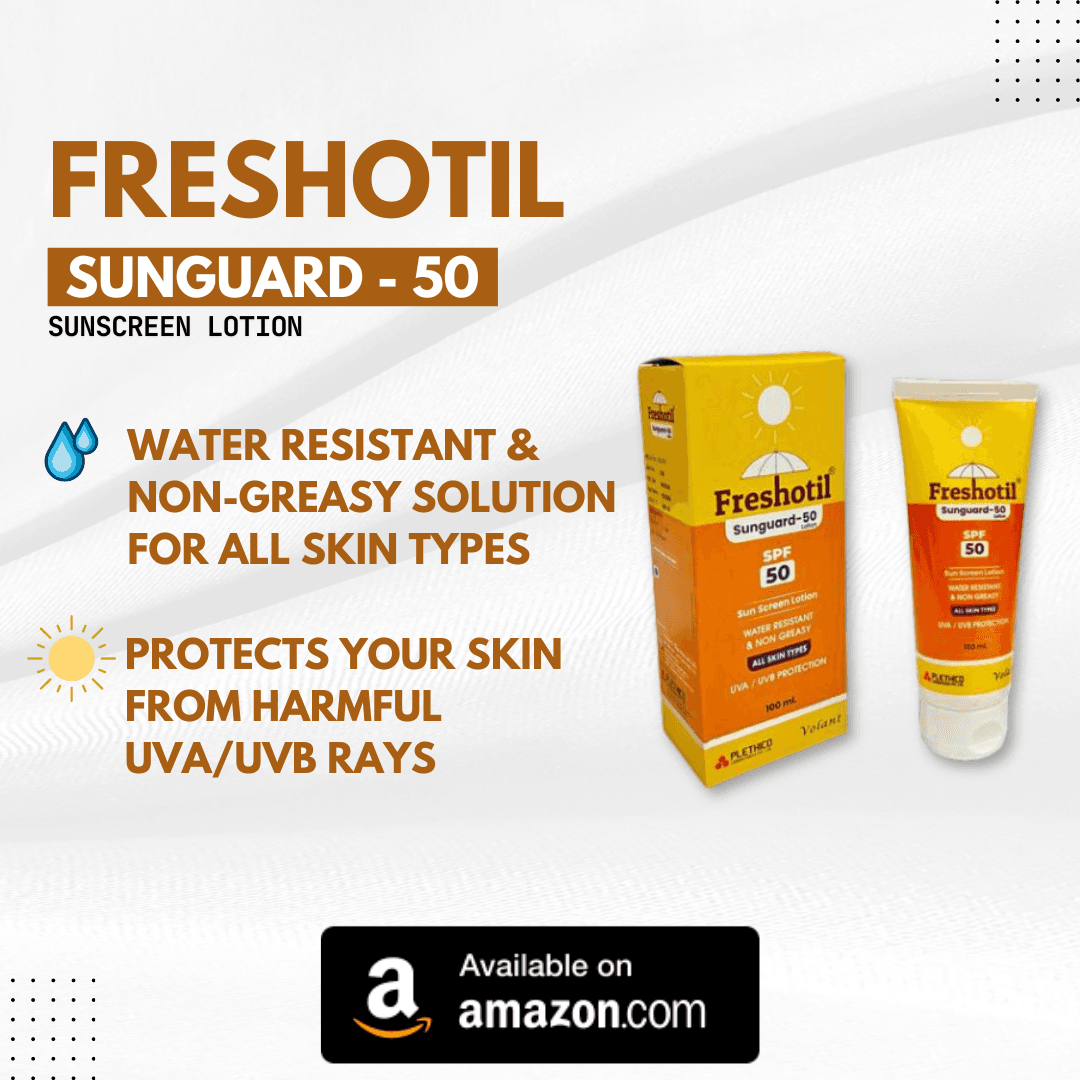
SPF 50 PA++++ · Non-Comedogenic · Matte Finish · No White Cast on Indian Skin
Sunscreen built specifically for acne-prone Indian skin — not repurposed from a dry-skin formula.
Get Freshotil Sunguard-50 on Amazon →Broad-Spectrum SPF 50 — Full UV Protection for Indian Sun Intensity
India's geographic position means UV Index values between 10 and 12 — classified as "extreme" by WHO standards — are routine across the majority of the country for six to eight months of the year. In cities like Chennai, Hyderabad, Bengaluru, and Mumbai, daily UV exposure during peak hours (10 AM to 4 PM) is sufficient to cause significant DNA damage to skin cells, trigger melanin overproduction in existing post-acne marks, and suppress the skin's natural immune response to bacterial infection. SPF 30 filters approximately 97% of UVB radiation. SPF 50 filters approximately 98%. In high-UV environments, this additional 1% translates to meaningfully less cumulative damage over months and years of daily exposure. Broad-spectrum protection — which addresses both UVA (responsible for pigmentation, skin ageing, and immune suppression) and UVB (responsible for burning and direct DNA damage) — is non-negotiable in the Indian context. Many Indian consumers purchase SPF 30 on the basis that the difference from SPF 50 is minimal. The mathematical difference in filtered radiation is small; the practical difference in accumulated daily UV damage across India's high-UV environment over a year of use is not.
For acne-prone skin specifically, UVA radiation matters beyond its pigmentation and ageing effects. UVA penetrates glass windows and clouds — meaning indoor exposure in offices near windows, car travel, and overcast days all contribute to the UV load on acne-marked skin. A person who drives 30 minutes each way to work in a city like Bengaluru or Pune receives meaningful left-side facial UVA exposure from window glass that compounds PIH darkening over months. This makes daily SPF application — including on cloudy days and even when primarily indoors — the correct protocol for Indian skin managing active or healing acne.
Non-Comedogenic Formula — Clinically Rated Pore-Safe for Acne Skin
Comedogenicity — the tendency of an ingredient to clog pores and trigger acne — is rated on a scale of 0 to 5, where 0 is completely pore-safe and 5 is highly likely to cause breakouts. Many conventional sunscreens contain ingredients rated 3 to 5 on this scale: isopropyl myristate (rated 5), coconut oil (rated 4), certain silicones, heavy emollients, and some UV filter solvents. Applied daily to acne-prone skin, these ingredients progressively worsen pore congestion — which is precisely why many people with acne have concluded, incorrectly, that sunscreen itself causes their breakouts rather than the specific formula they were using. A properly non-comedogenic sunscreen contains only ingredients rated 0 to 1 on the comedogenicity scale — with UV filters in water-dispersible or alcohol-free bases, lightweight hydrating compounds, and none of the heavy emollients that clog follicle openings. The result is a formula that sits on the skin's surface providing UV filtration without the occlusive layer that traps sebum and C. acnes bacteria in the follicle environment.
This distinction between "oil-free" and "non-comedogenic" is one of the most important and most commonly misunderstood in the acne skincare category. An oil-free sunscreen replaces conventional oils with other occlusive agents — silicones, waxes, or synthetic emollients — some of which have equal or higher comedogenic ratings than the oils they replace. A non-comedogenic formula, by contrast, has been specifically formulated and tested to confirm that none of its ingredients, individually or in combination, triggers follicle blockage in acne-prone skin. For Indian consumers managing active acne, this distinction determines whether their SPF protection heals or harms the skin it is meant to protect.
Matte Finish and Sebum Control — Oil Management Built Into the Formula
India's climate creates a specific challenge for oily, acne-prone skin that no other country's skincare culture fully grasps: the combination of high ambient temperature, high humidity — particularly in coastal cities and during monsoon across the country — intense UV radiation, and pollution creates conditions where sebum overproduction is both more severe and more consequential than in temperate climates. The skin's sebaceous glands respond to heat by increasing sebum output. Humidity prevents the skin's natural moisture evaporation that partially moderates this production. The result is excess oil on the surface that mixes with pollution particles, creates an environment for bacterial proliferation, and — when trapped under an occlusive sunscreen — directly feeds new acne formation. A matte-finish sunscreen formula addresses this through active sebum-absorbing components built into the base rather than applied as a separate step. Ingredients such as silica microspheres, kaolin clay, and specific mattifying polymers absorb sebum produced throughout the day into the formula itself, reducing surface shine and — more importantly for acne skin — reducing the sebum available to mix with comedogenic environmental particles and clog pores.
The practical benefit of this integrated matte function is a significant reduction in the midday oiliness cycle that most acne-prone Indian skin sufferers experience as inevitable. The pattern of clean skin at 8 AM becoming noticeably oily and prone to touch-triggered breakouts by noon is driven by the combination of sebum production and the absence of absorption. A mattifying sunscreen interrupts this cycle not by suppressing sebum production — which would require systemic intervention — but by absorbing it at the surface as it is produced, keeping the skin cleaner and reducing the window during which pore congestion can develop. For those who cannot reapply sunscreen midday due to office environments, this extended matte function is particularly valuable.
PIH Protection — Preventing Post-Acne Marks From Deepening
Post-inflammatory hyperpigmentation is the single most common and most complained-about consequence of acne on Indian skin — and it is a consequence that sunscreen addresses more effectively than any other single product in a skincare routine. When an acne lesion heals, it leaves behind an area of increased melanin production in the skin — a flat mark ranging from pink in lighter Indian skin tones to dark brown or purple-black in deeper tones. These marks can persist for six to twenty-four months without UV protection, and for three to six months with consistent, correctly applied SPF 50 broad-spectrum coverage. The mechanism is straightforward: UV radiation stimulates melanocytes — the cells responsible for melanin production — in the vicinity of the PIH mark, causing them to produce additional melanin that deepens and spreads the discolouration. Every day of unprotected UV exposure to a healing PIH mark potentially adds weeks to its fading timeline. Conversely, consistent daily broad-spectrum SPF 50 application over healing marks suppresses this UV-driven melanin stimulation, allowing the skin's natural turnover cycle to gradually replace hyperpigmented cells with normally pigmented ones.
This is why dermatologists universally recommend sunscreen as the first step in PIH management — before vitamin C, before niacinamide, before kojic acid, before any brightening active. Those actives work by suppressing or dispersing melanin that has already been produced. Sunscreen prevents the production of additional melanin that would undo their work. Using brightening actives without daily SPF protection is the skincare equivalent of mopping water from a floor while leaving the tap running. The combination of a non-comedogenic SPF 50 applied daily with appropriate brightening actives in the evening routine typically reduces PIH fading timelines from twelve to twenty-four months without protection to three to six months with it — a difference that is genuinely life-changing for the self-confidence of Indian adults managing post-acne skin.
How to Apply Sunscreen Over an Acne Skincare Routine
Application order, quantity, and technique determine whether you receive the SPF protection on the label. Most people get at least one of these three wrong.
Cleanse Thoroughly Before Any SPF Application
Sunscreen applied to a dirty face traps pollution particles, excess sebum, and residual product beneath the UV filter layer — directly worsening pore congestion. Use a gentle, low-pH cleanser appropriate for acne-prone skin every morning before sunscreen. Do not skip this step even when rushing.
Apply Actives and Toners First — Allow Full Absorption
If your morning routine includes toners, essences, niacinamide serums, or vitamin C, apply them in order of thinnest to thickest consistency before sunscreen. Allow each layer to absorb for 60 seconds minimum. Sunscreen applied over unabsorbed actives dilutes both the active and the SPF filter — reducing effectiveness of both.
Use the Correct Amount — Two Finger-Lengths or Half a Teaspoon
SPF testing uses 2 mg per cm² of skin — significantly more than most people apply daily. The practical guideline is two finger-lengths of sunscreen for the face alone, or approximately half a teaspoon. Under-application is the most common reason sunscreen users receive less protection than the SPF number indicates. Acne-prone skin is not exempt from this requirement.
Apply to All Sun-Exposed Areas — Including Neck and Ears
The neck, ears, and décolletage are equally exposed to UV radiation and equally susceptible to PIH acceleration on healing acne marks. Apply sunscreen to all these areas as part of the morning routine. For Indian urban commuters, the back of hands also deserves consistent attention.
Allow to Set for Three to Five Minutes Before Makeup or Touching
Allow sunscreen to set before applying any makeup or touching the face. Disturbing the sunscreen film before it has set disrupts the uniformity of the UV filter layer — creating areas of reduced protection adjacent to areas of excess product rather than the smooth, consistent film that delivers the rated SPF.
Reapply Every Two Hours if Outdoors or After Significant Sweating
SPF protection degrades with UV exposure, sweat, and rubbing. For outdoor activity, reapplication every two hours maintains the rated protection level. In air-conditioned indoor environments, a single morning application maintained without face touching remains effective through a standard workday.
What to Expect — Skin Improvement Timeline With Consistent SPF Use
Sunscreen results are measured in what does not happen and what fades faster. Here is the honest timeline of what consistent SPF 50 delivers for acne-prone Indian skin.
The first milestone: a non-comedogenic formula does not trigger new acne within the first week of use. If new breakouts appear, assess whether they are at sunscreen application sites (possible comedogenic reaction) or in locations where actives are used (possible purging). A truly non-comedogenic sunscreen should not cause site-specific new lesions.
With consistent daily SPF 50 application, the progressive darkening of post-acne marks begins to halt. Marks that were noticeably darker each week stabilise in colour. This is UV-driven melanin stimulation being blocked. Fading begins in subsequent weeks — stabilisation is the first visible signal the sunscreen is working.
With new melanin production suppressed, the skin's natural cell turnover cycle begins replacing hyperpigmented surface cells with normally pigmented ones. Marks appear lighter, particularly compared to photographs from the start of the SPF routine. Overall skin tone begins to even across the face.
Consistent daily SPF 50 combined with appropriate actives produces measurably significant PIH fading by month three to six. Marks that previously required heavy coverage to conceal reach or approach the threshold where a light coverage product suffices. This is the timeline dermatologists reference — consistency is the only variable.
Complete Buying Guide — Choosing a Sunscreen for Acne-Prone Indian Skin
The Indian sunscreen market offers hundreds of options and no shortage of misleading claims. Here is the precise framework for evaluating any sunscreen before purchase.
The Three Most Expensive Sunscreen Mistakes Indian Acne Skin Makes
The first and most consequential mistake is abandoning sunscreen after a bad experience with a comedogenic formula. The logic — "sunscreen broke me out, so sunscreen is bad for acne" — is the equivalent of concluding that all food is dangerous after eating something spoiled. The formula was wrong; the category is not. A person who quits sunscreen after a comedogenic reaction accepts permanent PIH deepening as an alternative to spending fifteen minutes identifying a non-comedogenic formula. The cost of that decision, measured in months of extended PIH duration and the associated confidence impact, vastly outweighs the effort of finding the right product.
The second mistake is relying on the SPF in foundation, BB cream, or tinted moisturiser as the primary sun protection strategy. SPF testing is conducted at a standardised application density of 2 mg per cm² of skin. The average person applying foundation applies approximately 0.5 to 1 mg per cm² — one quarter to one half of the required density. At that application density, an SPF 30 foundation delivers approximately SPF 5 to 8 of actual protection. Indian skin managing active acne and PIH under Indian UV conditions cannot afford to build a sun protection strategy on this mathematical fiction.
The third mistake is purchasing sunscreen by price alone. The Indian market has excellent non-comedogenic formulas across price points — but the cheapest options are disproportionately likely to contain comedogenic emollients, inadequate UVA coverage, and fragrance compounds that sensitise reactive acne skin. A sunscreen that triggers fresh breakouts costs more — in time, in additional treatment products required, in extended PIH duration — than any premium paid for a correctly formulated product. For acne-prone skin, sunscreen is not an area where economising on formula quality produces net savings.
The right SPF formula exists. Your skin deserves it.
Non-comedogenic. SPF 50 PA++++. Matte finish. No white cast on Indian skin tones.
Shop Freshotil Sunguard-50 on Amazon →Who Needs This Sunscreen Most
Office Workers With Daily Commutes
Even short outdoor commutes in Indian cities deliver meaningful UV exposure. Car window glass blocks UVB but not UVA — the ray responsible for PIH darkening. Daily SPF is non-negotiable for city commuters.
Students With Active Breakouts
The combination of hormonal acne, stress-related flares, and outdoor campus exposure makes SPF protection one of the highest-leverage skincare investments for Indian students managing active breakouts.
Adults Using Retinoids or AHAs
Retinoids and exfoliating acids dramatically increase UV photosensitivity. Using these actives without daily SPF 50 accelerates the UV damage they are meant to address. Sunscreen is mandatory alongside prescription or OTC retinoids.
South Indian and Coastal City Residents
Chennai, Kochi, Mangaluru, Vizag — year-round UV Index extremes make daily SPF 50 a baseline health requirement. Post-acne skin in these cities fades significantly slower without consistent broad-spectrum protection.
Outdoor Workers and Two-Wheeler Commuters
Motorcyclists and cyclists face both extreme UV exposure and wind-driven particulate pollution directly on the skin. Sunscreen is the critical first line of defence for this heavily exposed group.
Makeup Wearers Relying on Foundation SPF
SPF in makeup products is never applied in the 2 mg/cm² quantity required to achieve the rated protection. Those relying on SPF-containing foundations as their sole sun protection receive a fraction of the labelled SPF.
Night Routine Devotees Who Skip Mornings
A comprehensive evening routine of actives produces zero long-term benefit if UV damage reverses it each morning. Sunscreen is the step that makes every night product worth using.
Fitzpatrick Skin Types IV–VI — Deeper Indian Tones
Darker skin tones have more active melanocytes and a higher baseline risk of PIH from any inflammatory trigger. The misconception that dark skin needs no sunscreen is a primary driver of prolonged PIH in Indian adults.
Sunscreen Myths That Are Actively Making Your Acne Worse
People with acne should skip sunscreen because it clogs pores
Unprotected acne skin is a clinical problem, not just an aesthetic one. UV radiation suppresses the skin's local immune response — one of its primary defences against C. acnes overgrowth — and dramatically accelerates PIH darkening. The issue is not sunscreen; it is a comedogenic formula. A properly non-comedogenic SPF 50 is one of the most important products in an acne routine, not a product to avoid.
Dark Indian skin does not need sunscreen because it has natural UV protection
Higher baseline melanin provides approximately SPF 2–4 of natural protection — far less than the SPF 50 recommended for Indian UV exposure levels. More critically, higher melanin activity means darker Indian skin tones are more prone to PIH from acne, not less. The melanocytes that produce protective melanin also overproduce it in response to inflammation, making SPF more important for deeper skin tones in the context of acne management.
Sunscreen needs to be washed off immediately every night to prevent damage
Sunscreen should be removed each evening with a proper cleansing routine — the driver is hygiene and removal of accumulated UV-degraded filters, pollution particles, and sebum, not a specific toxicity of the sunscreen itself. A non-comedogenic formula does not continuously damage pores while on the skin; it becomes a problem only when left with accumulated daily pollution without evening cleansing.
SPF 30 is perfectly adequate for Indian sun — SPF 50 is excessive marketing
In moderate UV environments, the difference between SPF 30 and SPF 50 is minor. In India's extreme UV environment, the additional UVB filtration matters cumulatively. More critically, PA++++ UVA protection — typically associated with higher-SPF formulas — is what primarily determines PIH outcome on acne skin. For Indian skin managing post-acne marks, SPF 50 PA++++ is the clinical standard.
Sunscreen makes oily skin oilier and should be avoided in summer
The wrong sunscreen makes oily skin oilier. A mattifying, non-comedogenic formula with sebum-absorbing ingredients actively manages oil throughout the day. Avoiding sunscreen in summer — India's highest UV period — maximises UV-driven PIH darkening precisely when UV intensity is greatest. If summer heat makes current sunscreen intolerable, change the formula rather than abandoning SPF.
Vitamin C serum provides enough antioxidant protection to replace sunscreen
Vitamin C is a potent antioxidant that neutralises free radicals generated by UV exposure — it is an excellent complement to sunscreen, not a replacement. Antioxidants manage downstream damage caused by UV photons already absorbed by the skin. Sunscreen prevents those photons from reaching skin cells in the first place. These are sequential, complementary mechanisms — not alternatives to each other.
Frequently Asked Questions — Sunscreen for Acne-Prone Skin India
Can sunscreen actually make acne worse?
A comedogenic sunscreen absolutely can worsen acne — this is why formula selection is critical. Sunscreens containing highly comedogenic emollients, certain silicones, or occlusive bases can block pores, trap sebum, and directly trigger new lesions in acne-prone skin. However, this is a formula problem, not a sunscreen category problem. A properly non-comedogenic SPF 50 formula not only does not worsen acne — it actively prevents UV-driven PIH deepening and immune suppression that compounds acne severity. The issue is choosing the right product, not avoiding the category.
What SPF is sufficient for acne-prone Indian skin?
The clinical recommendation for Indian skin managing active acne or post-inflammatory hyperpigmentation is SPF 50 PA+++ minimum, applied in adequate quantity — half a teaspoon for the face — and reapplied every two hours if outdoors. SPF 30 is insufficient for India's UV Index levels during peak months. The PA rating indicating UVA protection is as important as the SPF number for PIH management. Look for PA+++ or PA++++ alongside SPF 50 for complete broad-spectrum coverage.
How do I apply sunscreen if I am already using retinol or salicylic acid?
Retinoids and salicylic acid are typically evening-use actives that should not overlap with sunscreen in the morning routine. Apply them only at night, then apply sunscreen the following morning as part of your daytime routine. If you use salicylic acid in a morning cleanser or toner, apply it first, allow it to absorb fully, and then apply sunscreen as the final step before any makeup. Both types of actives increase photosensitivity — making sunscreen even more critical, not less.
Does sunscreen need to be reapplied indoors?
In a typical indoor office environment with no direct window sun exposure and no outdoor activity, a carefully applied morning sunscreen maintains meaningful protection through a standard workday without reapplication. However, if you sit near windows with significant natural light, commute by car, or step outdoors at lunch, the morning application should be followed by reapplication at the two-hour mark after initial sun exposure begins. UVA penetrates glass, so window proximity requires consideration for those managing active PIH.
Can I wear makeup over sunscreen if I have acne?
Yes — apply sunscreen as the final skincare step, allow three to five minutes to set, then apply makeup on top. Choose non-comedogenic makeup products to maintain the overall pore-safety of the routine. Do not use SPF-containing foundation as your primary sun protection — the quantity applied in practice is always far less than the 2 mg/cm² required to deliver the labelled SPF. Think of SPF in makeup as a minor bonus, not your sun protection strategy.
Is physical or chemical sunscreen better for acne-prone skin?
This is nuanced rather than absolute. Physical sunscreens with zinc oxide and titanium dioxide are less likely to cause allergic reactions and work immediately upon application — but historically produced white cast on Indian skin tones and required textures some acne-prone users found too heavy. Modern chemical filters are generally lighter and invisible — but specific filters like oxybenzone can cause sensitisation in very reactive skin. The most practical approach for Indian acne-prone skin is a well-formulated hybrid formula using micronised physical filters with modern chemical co-filters in a lightweight, non-comedogenic base.
Should I use sunscreen if I have active acne lesions?
Yes — active lesions are the skin condition that most urgently requires UV protection. An inflamed active lesion has a disrupted barrier and elevated melanocyte activity, meaning UV exposure to it is significantly more damaging than UV exposure to healthy surrounding skin. Skipping sunscreen over active lesions leaves them at maximum risk of darkening into prolonged PIH marks. Apply sunscreen gently to active areas using patting motions rather than rubbing to avoid mechanical irritation.
How long before sun exposure should I apply sunscreen?
For chemical sunscreen filters, a 15 to 20 minute pre-exposure application window allows filters to bind to the skin and activate fully. Physical filters — zinc oxide, titanium dioxide — work immediately upon application with no waiting required. As a practical morning routine rule, applying sunscreen as the last step before getting dressed and then leaving the house typically provides an adequate absorption window regardless of filter type. Do not apply sunscreen on the move — it should be applied to still, relaxed skin.
Can I use sunscreen during a course of isotretinoin?
Daily sunscreen use is strongly recommended — and typically explicitly prescribed — during isotretinoin therapy. Isotretinoin dramatically increases skin photosensitivity by thinning the outer skin layer and reducing its natural UV resilience. Dermatologists prescribing isotretinoin universally recommend SPF 50 broad-spectrum daily application as a mandatory accompaniment to the medication. A non-comedogenic formula is particularly appropriate during isotretinoin therapy, as the skin barrier is compromised and reactivity is elevated.
What is the correct order for sunscreen in a morning skincare routine?
The correct order is: cleanser → toner or essence (if used) → vitamin C or other water-based actives → lightweight moisturiser (if needed) → sunscreen as the final step. No product should be applied over sunscreen in the skincare routine, though makeup can be applied on top after sunscreen has set for three to five minutes. This order ensures the UV filter sits at the outermost layer of the skin where it can intercept UV radiation before it reaches skin cells.
Your Post-Acne Marks Are Waiting for This
The marks left by acne are not permanent — but without daily SPF 50 broad-spectrum protection, they effectively become so. Every morning without sunscreen is a morning of UV-driven melanin stimulation that adds time to the fading timeline and undermines every treatment in your routine. A non-comedogenic SPF 50 PA++++ sunscreen that does not clog pores, does not leave a white cast, and does not make your skin oilier is not a difficult ask — it is a product that acne-prone Indian skin has always deserved.
Buy Freshotil Sunguard-50 on Amazon →Non-Comedogenic · SPF 50 PA++++ · All Indian Skin Tones · No White Cast · Free Delivery Available