Best Sunscreen for
Oily Skin in India
The Complete SPF 50 Guide (2026)
Most sunscreens ruin oily skin. They pile on the grease, block your pores, and melt off the second you step outside. This guide cuts through everything — so you finally know what to look for, what to avoid, and which SPF 50 sunscreen actually works for Indian skin in Indian weather.
Why Sunscreen Is the Most Skipped — and Most Important — Skincare Step in India
Ask a dermatologist what the single most impactful thing an Indian person can do for their skin, and the answer is almost universally the same: wear sunscreen every day. Not a vitamin C serum. Not an expensive night cream. Sunscreen — applied correctly, every morning, without exception.
And yet sunscreen remains the most skipped step in most Indian skincare routines. The reasons are understandable: most formulas feel awful on oily skin, they break out acne-prone faces, they slide off in the humidity, and the options available until recently were either too light to be effective or too heavy to be wearable.
India's UV Index is among the highest in the world. Most cities in central and southern India see UV Index readings of 8–11 from February through October — levels classified as "Very High" to "Extreme" by the WHO. At UV Index 10, unprotected fair skin can begin to sustain damage in under 10 minutes. And unlike sunburn, the majority of this UV damage — the kind that causes dark spots, hyperpigmentation, premature wrinkles, and long-term skin cancer risk — is invisible in the moment. It accumulates silently, day after day, until suddenly your skin looks significantly older than it should, your pigmentation is uneven, and reversing the damage requires expensive treatments that could have been avoided entirely.
The good news: the solution is simple and inexpensive. A good SPF 50 broad-spectrum sunscreen, applied every morning, prevents the vast majority of this damage before it can begin. This guide tells you everything you need to know to do that correctly — and introduces the formula we recommend for oily skin specifically.
The 4 Reasons Oily Skin and Sunscreen Don't Get Along — and How to Fix It
If you have oily skin and you've given up on daily sunscreen because it always makes things worse — here's exactly what's going wrong, and why the right formula changes everything.
Every Sunscreen Makes Your Face Greasy
Most sunscreens are formulated with heavy oils and emollients that work beautifully on dry skin — but turn oily skin into a shine disaster within the hour. By mid-morning, your face looks like it's been deep-fried.
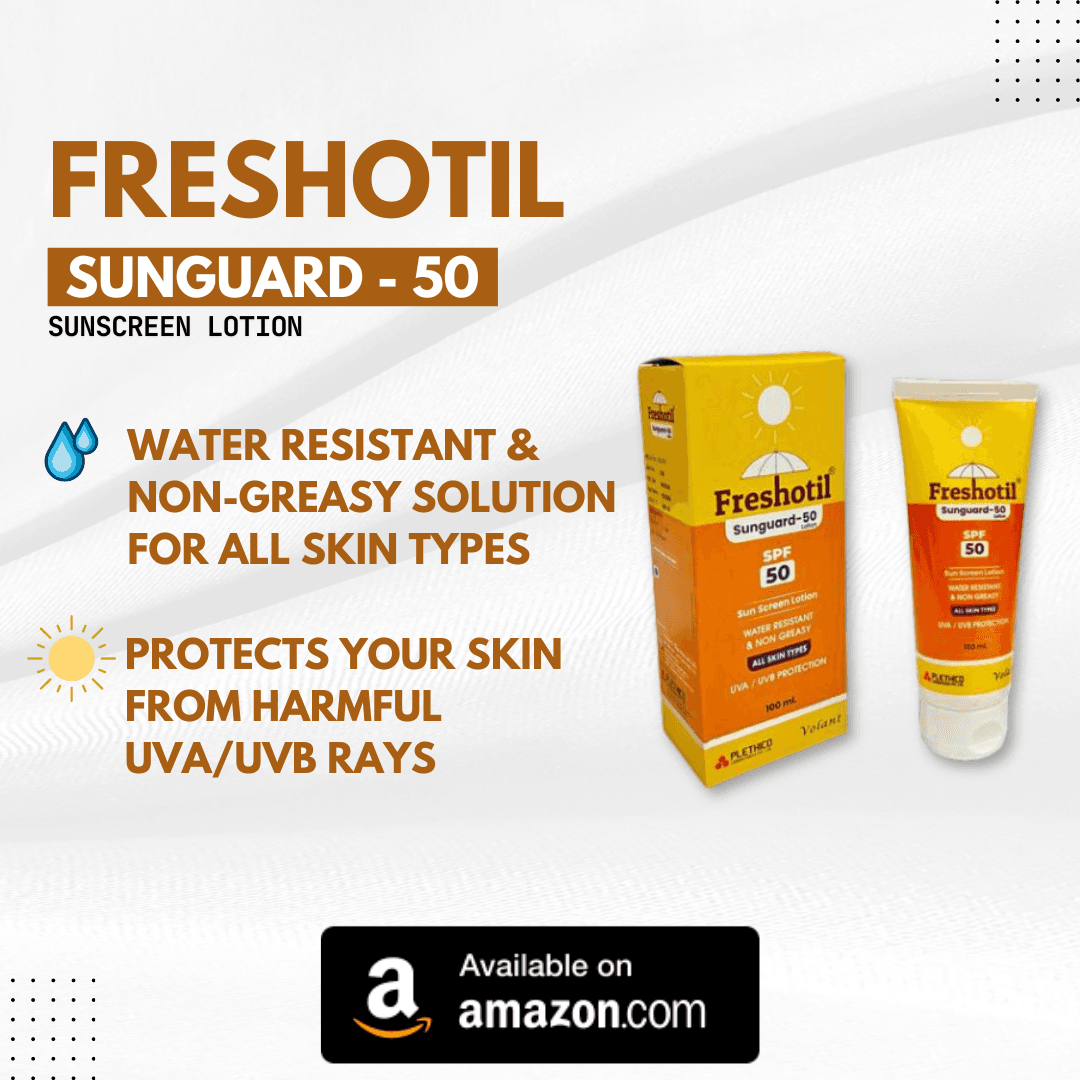
Freshotil Sunguard 50 uses a lightweight, fast-absorbing base that leaves zero greasy residue — just clean, protected skin that breathes.
Sunscreen Clogs Pores and Causes Breakouts
Comedogenic sunscreen ingredients trap sebum under the skin, creating the perfect breeding ground for acne bacteria. If your skin breaks out every time you use sunscreen, you're using the wrong formula.
The non-comedogenic formulation of Sunguard 50 sits on top of the skin without blocking pores — protecting without provoking breakouts.
It Washes Off the Moment You Sweat
India's heat and humidity means you start sweating the moment you step outside. Non-water-resistant sunscreens lose their protection within 20–30 minutes outdoors — leaving you exposed without knowing it.
Sunguard 50 is water-resistant — maintaining its SPF 50 protection even through sweating, swimming, and outdoor activity.
You Stop Applying Because It Feels Awful
The biggest sunscreen problem in India is inconsistency. People know they should wear it — but thick, sticky formulas are so unpleasant that most people simply stop. No sunscreen is worse than imperfect sunscreen.
A formula that feels light and comfortable enough to use every single day, morning after morning, without dreading the application.
The SPF Science: What You Actually Need to Know
SPF labelling is one of the most misunderstood rating systems in skincare. Here is what the numbers actually mean — and why they matter specifically for people with oily skin in India.
What Does SPF Actually Mean?
SPF stands for Sun Protection Factor. SPF 50 means the product filters approximately 98% of UVB rays when applied correctly. SPF 30 filters around 97%. The difference seems small — but in India's UV Index, that extra 1% of UVB blocked matters significantly over cumulative daily exposure. SPF 50 is the current dermatological gold standard for daily use in tropical climates.
UVA vs UVB — What's the Difference?
UVB rays cause immediate sunburn and are the primary cause of skin cancer. UVA rays penetrate deeper into the skin — they don't burn but they do age. UVA is responsible for dark spots, fine lines, loss of collagen, and the leathery texture of sun-damaged skin. In India, both are present at high intensity year-round. You need broad-spectrum protection against both — which is exactly what Sunguard 50 provides.
Why Water Resistance Matters in Indian Weather
Most Indians are outdoors in temperatures that cause sweating within minutes. Sweat dilutes and breaks down most sunscreen formulas rapidly. A water-resistant sunscreen maintains its protective layer under sweat and humidity — which means you're actually getting the SPF stated on the label, not a degraded version of it.
How Much Sunscreen Should You Actually Apply?
The standard recommendation is 2 mg per cm² of skin — which translates to roughly ¼ teaspoon (1.25ml) for the face alone, and about 35ml (more than 6 teaspoons) for the full body. Most people apply less than half the required amount, which dramatically reduces the effective SPF. Under-application is the most common sunscreen mistake.
Does SPF in Moisturiser or Foundation Count?
SPF in makeup and moisturiser is not a substitute for dedicated sunscreen. These products are applied too thinly to deliver meaningful protection — the SPF advertised is based on a much thicker application than you'd use for a foundation or BB cream. Always apply a dedicated sunscreen underneath makeup.
SPF 50. Broad Spectrum. Non-Greasy. Water Resistant.
Freshotil Sunguard 50 — the daily sunscreen built for oily skin and India's intense UV conditions.
Get Freshotil Sunguard 50 on Amazon →Why India's Sun Is More Dangerous Than You Think
Most Indians are significantly underestimating their UV exposure. The common assumption is that sun damage is primarily a beach holiday problem — something to worry about on vacation, not on a regular Tuesday commute. This misunderstanding is responsible for a significant amount of preventable skin damage.
India sits predominantly between 8°N and 37°N latitude — well within the tropical and subtropical bands where UV radiation is most intense. The combination of proximity to the equator, high altitudes in many regions, and low cloud cover for much of the year means India receives some of the highest UV doses of any inhabited region on earth.
Cities like Mumbai, Chennai, Hyderabad, and Bangalore regularly record UV Index values above 10 for five to seven months of the year. Even Delhi, Pune, and Kolkata — further north or with more cloud cover — see UV Index readings of 8+ for most of the year. The World Health Organization classifies UV Index 8 as "Very High" — a level at which unprotected skin exposure should be minimised and protective measures taken.
The insidious part is that most UV damage is invisible when it happens. UVA rays — which cause the majority of ageing, hyperpigmentation, and cumulative DNA damage — don't cause sunburn. You don't feel them working. They penetrate through windows, through cloud cover, and through every unprotected moment outdoors. The damage is only visible months or years later — as uneven skin tone, dark patches, fine lines, loss of elasticity, or in more serious cases, as skin pathology requiring medical attention.
The corrective treatments for UV-induced skin damage — laser therapy, chemical peels, prescription brightening treatments — cost significantly more than daily sunscreen application. Prevention is not just more effective; it is dramatically more economical than treatment.
What Makes Sunguard 50 Work: The Formula Behind the Protection
Not all sunscreens are equal — and the gap is widest when it comes to oily skin formulations. Here's what makes Freshotil Sunguard 50's formula genuinely effective for daily use in India.
Broad-Spectrum UVA/UVB Filters
Comprehensive Solar Protection
Broad-spectrum UV filters are the functional core of any effective sunscreen. They work by absorbing or reflecting UV radiation before it can penetrate and damage skin cells. SPF 50 broad-spectrum coverage blocks approximately 98% of UVB rays and provides substantial UVA protection — the two wavelengths responsible for sunburn, premature ageing, hyperpigmentation, and skin cancer. Without broad-spectrum coverage, you're only solving half the sun damage problem.
Water-Resistant Formula Base
Protection That Lasts Through Sweat and Activity
The water-resistant base in Sunguard 50 ensures that the UV filters remain bonded to the skin's surface even under sweating, humidity, and water exposure. Standard sunscreens break down and wash off quickly in India's climate. A water-resistant formula maintains integrity for significantly longer — reducing the frequency of reapplication needed and ensuring the stated SPF is actually being delivered to your skin throughout the day.
Lightweight Non-Comedogenic Base
No Grease. No Breakouts. No Compromise.
The challenge of formulating for oily skin is creating a sunscreen that provides genuine protection without the heavy, pore-clogging emollients that most SPF formulas rely on. Sunguard 50's lightweight base is non-comedogenic — meaning it is specifically formulated to avoid blocking pores. This makes it safe for daily use even on acne-prone and combination skin types, without the breakout risk associated with many traditional sunscreen formulations.
Sunguard 50 vs. Typical Indian Sunscreens: A Side-by-Side
Most affordable sunscreens in India make compromises that specifically hurt oily skin users. Here's a direct comparison:
| Factor | Freshotil Sunguard 50 | Typical Sunscreen |
|---|---|---|
| SPF Level | SPF 50 | SPF 15–30 |
| Spectrum | Broad Spectrum (UVA + UVB) | Often UVB only |
| Texture | Non-greasy, lightweight | Heavy, oily residue |
| Water Resistance | ✓ Yes | ✗ Often not water-resistant |
| Daily Wear Comfort | Breathable, all-day fresh feel | Uncomfortable after 2–3 hours |
| Suitable for Oily Skin | ✓ Non-comedogenic | Frequently clogs pores |
How to Apply Sunscreen Correctly (Most People Are Doing This Wrong)
The most common sunscreen mistake is not application frequency — it's application amount and order. Follow this protocol for maximum effectiveness.
Cleanse your face first
Apply sunscreen to clean skin — not over layers of products. Excess oil or residue from overnight cream can prevent even adhesion.
Serums and moisturiser first
If you use a vitamin C serum or lightweight moisturiser, apply those before sunscreen. Allow them to absorb for 30–60 seconds.
Apply generously — a full ¼ teaspoon for the face
Most people under-apply by 50–75%. The SPF 50 rating assumes full coverage. Thin application delivers dramatically lower effective protection.
Cover all exposed areas
Don't neglect the neck, ears, and back of hands — areas frequently missed and among the first to show sun ageing.
Apply 15–20 minutes before sun exposure
Chemical sunscreen filters need time to bind to the skin. Apply before you leave the house, not as you step outside.
Reapply every 2 hours outdoors
UV exposure degrades sunscreen filters. Reapplication every 2 hours maintains effective protection for sustained outdoor time.
💡 Pro tip for oily skin: Use a blotting paper or mattifying powder before reapplying sunscreen midday — this removes excess oil without disturbing the base layer of protection, and the fresh sunscreen application goes on more evenly. Pair your daily sunscreen routine with a good cleanser — our FreshOLite Vitamin C Face Wash guide covers the best morning cleanse before sunscreen application.
6 Sunscreen Mistakes Indians Make (And How to Fix Them)
Even people who do wear sunscreen regularly are often making errors that significantly reduce their protection. These are the most common — and most impactful — mistakes.
Applying Too Little
The SPF number on the bottle is tested at 2mg/cm². Most people apply a thin layer — which can deliver as little as SPF 10–15, regardless of what the label says. Use a full, generous amount.
Not Reapplying
Sunscreen degrades under UV exposure and washes off with sweat. Reapply every 2 hours outdoors, or after heavy sweating or swimming. Even water-resistant formulas need reapplication after extended activity.
Skipping on Cloudy Days
Up to 80% of UV rays penetrate cloud cover. India's UV Index remains dangerous on overcast days — particularly in summer. Daily application regardless of visible sunshine is the correct habit.
Only Applying to the Face
The neck, ears, back of hands, and forearms are among the most sun-exposed body parts — and among the first to show signs of photoageing. Apply to all exposed skin, not just the face.
Using SPF in Foundation as Your Only Sunscreen
Foundation and tinted moisturisers with SPF are applied far too thinly to deliver meaningful protection. They are a supplement, not a substitute for a dedicated sunscreen application.
Waiting Until Summer
UVA rays — which cause ageing and hyperpigmentation — are present at consistent intensity year-round, not just in summer. Daily sunscreen in January protects your skin as much as daily sunscreen in May.
What Daily SPF 50 Actually Does to Your Skin — Over Time
Sunscreen benefits are cumulative. Here's the realistic timeline of what consistent daily use of Sunguard 50 achieves for your skin:
Skin feels protected but light — no stickiness or shine amplification. Comfortable all day.
T-zone oil production does not worsen. Skin stays fresher longer through the day.
No new sunburn-related dark spots forming. Existing hyperpigmentation stops worsening.
Cumulative UV damage prevention becomes visible — tone is more even, fewer new spots appearing.
Consistent SPF use is one of the most evidence-backed anti-ageing interventions available. Long-term users show significantly less photoageing than non-users.
Who Should Use Freshotil Sunguard 50?
Oily & Combination Skin
Non-greasy formula that protects without amplifying shine or blocking pores.
Active & Outdoor Lifestyles
Water-resistant protection built for sport, commuting, and outdoor work in Indian heat.
Urban Commuters
Daily broad-spectrum protection against the UV + pollution combination in Indian cities.
Hyperpigmentation & Dark Spots
SPF 50 stops UV from worsening existing pigmentation — a critical step in any brightening routine.
Men's Daily Skincare
Fast-absorbing, residue-free formula practical for men who want protection without heavy skincare.
Anti-Ageing Prevention
The most evidence-backed anti-ageing intervention available — protecting collagen from daily UV degradation.
Daily SPF is not optional in India. The only question is which one.
Freshotil Sunguard 50 — SPF 50 broad-spectrum, water-resistant, and actually wearable for oily skin.
Order Freshotil Sunguard 50 on Amazon →Building a Complete Daily Routine Around Your Sunscreen
Sunscreen is most effective when it is part of a consistent skincare routine rather than a standalone step. The products you use before sunscreen affect how well it adheres; the products you use to cleanse in the evening affect how your skin is prepared for the next morning's application. Here's how to build a routine that maximises everything:
Morning Routine (The Protective Stack)
Begin with a thorough cleanse to remove nighttime product residue and morning oil buildup. For oily skin, this means using an active cleanser — ideally one with brightening properties like Vitamin C — rather than a plain foaming wash. This removes the surface oil that would otherwise compromise sunscreen adhesion.
After cleansing, apply any vitamin C serum or treatment products while the skin is still slightly damp — this is when active ingredient absorption is highest. Allow serums to absorb for 60–90 seconds, then layer your moisturiser if your skin needs it. For oily skin, a very lightweight gel moisturiser or skipping moisturiser entirely and relying on the sunscreen base for hydration is often the better choice.
The final step before leaving the house is sunscreen. Apply generously — remembering that under-application is the single most common reason sunscreen fails to deliver its stated protection. Allow Sunguard 50 to absorb for 1–2 minutes before applying makeup if needed.
Evening Routine (The Repair Stack)
In the evening, the priority shifts from protection to repair. Begin with a double cleanse if you've worn sunscreen and makeup — an oil-based or micellar cleanser first to break down the sunscreen film, followed by a water-based active cleanser. This is important: sunscreen that is not fully removed before sleeping can accumulate in pores overnight and contribute to congestion.
After cleansing, apply your most active treatment products — retinoids, niacinamide, brightening serums — while the skin barrier is most receptive. Follow with a richer moisturiser than your daytime product if dryness is a concern. The skin repairs and regenerates most actively during sleep, so the evening routine is when nourishing ingredients deliver their highest return on investment.
Pair your sunscreen routine with the right supporting products for complete coverage. Our guides on the best face wash for oily skin in India and the best moisturizer for combination skin cover the cleanser and moisturiser steps in detail.
Sunscreen for Oily Skin — Frequently Asked Questions
Is Freshotil Sunguard 50 suitable for oily skin?
Yes — it is specifically formulated to be non-greasy and lightweight, making it suitable for oily and combination skin types. It absorbs quickly without leaving a sticky or heavy residue.
Can I use this sunscreen every day?
Absolutely. Sunguard 50 is designed for daily use. Apply every morning as the last step of your skincare routine, before makeup if applicable. This daily habit is one of the highest-impact skin health decisions you can make.
How water-resistant is it?
Sunguard 50 is water-resistant, making it suitable for outdoor activities, sports, sweating, and water exposure. It maintains its protective properties significantly longer than non-water-resistant alternatives under Indian weather conditions.
Does SPF 50 protect against both UVA and UVB rays?
Yes. Sunguard 50 is a broad-spectrum formula providing protection against both UVA (ageing/pigmentation rays) and UVB (burning/cancer rays). This comprehensive coverage is what makes it effective for skin health, not just sunburn prevention.
Will it cause breakouts on acne-prone skin?
The formula is non-comedogenic — designed to not block pores. It is suitable for acne-prone skin types. That said, if you are experiencing active, severe acne, consult a dermatologist before introducing new products into your routine.
Can men use this sunscreen?
Yes. The lightweight, non-greasy formula is particularly practical for men who want sun protection without the feel of wearing heavy skincare. It absorbs quickly and leaves no visible residue.
How often should I reapply Sunguard 50?
For continuous outdoor exposure, reapply every 2 hours. If you are primarily indoors with limited sun exposure, morning application is sufficient for most days. After swimming or intense sweating, reapply regardless of timing.
Can I use this under makeup?
Yes. The lightweight, fast-absorbing formula makes it an excellent base under makeup. Apply sunscreen first, allow it to absorb for 1–2 minutes, then apply primer or foundation on top.
What is India's UV Index and why does it matter?
India's UV Index regularly reaches 8–11+ in most regions, particularly from March to September. Dermatologists classify UV Index 8 as "Very High" and anything above 11 as "Extreme." At these levels, unprotected skin can begin to burn in under 15 minutes. SPF 50 significantly extends that safe exposure window.
Is sunscreen just for summer?
No — this is one of the most common and damaging sunscreen myths in India. UVA rays maintain consistent intensity year-round and penetrate windows and cloud cover. The skin-ageing and pigmentation damage from UVA accumulates every day, regardless of season. Year-round daily application is the correct approach.
The Bottom Line: Sunscreen Is Not Optional in India
Dermatologists are consistent on this point: sunscreen is not a cosmetic luxury. In India's UV environment, it is a daily health essential — as fundamental to skin wellbeing as diet or hydration. The visible effects of skipping it accumulate invisibly for years before they become undeniable. By then, reversing the damage is far harder than the habit that would have prevented it.
The barrier to building a daily sunscreen habit has historically been product quality — heavy, greasy formulas that make oily skin worse, formulas that break out acne-prone skin, formulas that slide off in the heat before they have a chance to work. These problems are real, and they've caused millions of Indians to give up on SPF entirely.
The solution is not to give up on sunscreen. The solution is to find a formula engineered for the actual conditions of Indian skin and Indian weather. SPF 50 broad-spectrum protection, a genuinely lightweight non-greasy base, and water resistance for the sweat and humidity that comes with daily life outdoors. That's the checklist — and that's the formula Freshotil Sunguard 50 was built around.
One bottle. Every morning. Lasting, invisible protection against the damage that accumulates from every unprotected day outside. It is, without question, the highest-return skincare investment you can make.
Protect Your Skin. Every Single Day.
SPF 50 broad-spectrum protection, non-greasy formula, and water resistance designed for India's heat and humidity. Freshotil Sunguard 50 — the daily sunscreen that oily skin can actually wear.
Shop Freshotil Sunguard 50 on Amazon →SPF 50 · Broad Spectrum UVA/UVB · Water Resistant · Non-Greasy