Is Calamine Lotion Safe
for Daily Use in India?
The pink bottle in every Indian medicine cabinet. You know it works for sunburn, heat rash, and insect bites. But can you use it every day — on your face, on your body, as part of your regular skincare routine? The answer is more nuanced than you think. This complete dermatologist guide covers everything: skin types, side effects, application protocols, and when to choose a modern calamine formulation.
The Calamine Confusion: Why Every Indian Household Asks This Question
Walk into any Indian pharmacy — from a standalone medical store in a Mumbai suburb to a village clinic in rural Uttar Pradesh — and you will find the same pink bottle on the shelf. Calamine lotion is perhaps the most ubiquitous over-the-counter dermatological product in India, present in more medicine cabinets than paracetamol. And for good reason. It works. It soothes sunburn after a day at Juhu Beach. It calms the maddening prickle of heat rash during Chennai's monsoon. It dries out the weeping rash from an insect bite sustained during an evening walk in a Delhi park.
But here is the question that dermatologists hear weekly, sometimes daily: Can I use this every day? The teenage girl with persistent facial oiliness wants to know if she can apply it each morning before school. The middle-aged man who works outdoors in the Hyderabad sun wonders if daily application will protect his skin from the cumulative damage of heat and UV exposure. The mother of a toddler with recurrent heat rash asks if it is safe to apply at every diaper change.
The answer is not a simple yes or no — and the Indian context makes the question more complicated than it would be in milder climates. India's extreme seasonal variations — scorching dry heat in the north, oppressive humidity in coastal cities, the dramatic temperature shifts between winter and summer — mean that your skin's needs change dramatically throughout the year. A routine that works perfectly in a dry Bengaluru February may be entirely wrong for a humid Kolkata July. Add to this the diversity of Indian skin types — from very oily to very dry, with every combination in between — and the universal answer becomes impossible.
This guide provides the nuanced answer you need. We will cover the science of how calamine actually works at the cellular level, break down which skin types can safely use it daily and which cannot, explain the difference between traditional calamine and modern formulations like CALAFINE Lotion, and give you a step-by-step application protocol for daily use. By the end, you will know exactly whether daily calamine use is right foryour skin, in your climate, for your specific skin concerns.
What Calamine Actually Is — The Chemistry Behind the Pink Bottle
The Two Active Ingredients: Zinc Oxide and Ferric Oxide
Despite its name, traditional calamine lotion contains no calamine in the pharmaceutical sense. The modern formulation is a suspension of zinc oxide (ZnO) and ferric oxide (Fe₂O₃) — the latter being responsible for the characteristic pink colour — in a water-based solution with suspending agents that keep the particles evenly distributed. The zinc oxide comprises approximately 98% of the active content, with ferric oxide making up the remaining 2% primarily as a colorant.
Zinc oxide is the workhorse. It is an inorganic compound with remarkable dermatological properties: anti-inflammatory, mild antimicrobial, astringent, and protective. When applied to skin, zinc ions are released slowly over several hours, interacting with cell membrane proteins to modulate the inflammatory response. This is why calamine reduces redness, swelling, and pain — it actually changes the biological cascade of inflammation, it does not merely mask the symptoms.
How the Cooling Effect Actually Works
The immediate cooling sensation of calamine is not a chemical trick — it is evaporative thermodynamics. The water content in the lotion evaporates from the skin surface at a controlled rate, and the phase change from liquid to vapour requires energy. That energy is drawn as heat from the skin beneath, cooling the tissue by a measurable 2-4 degrees Celsius within minutes of application.
This cooling effect is particularly valuable for conditions involving trapped heat — sunburn, where UV radiation has deposited massive thermal energy into the dermis, and heat rash, where blocked sweat ducts prevent the body's natural evaporative cooling from reaching the skin surface. By providing external evaporative cooling, calamine bypasses the blocked ducts and delivers relief that the body cannot achieve on its own.
The Astringent Action Explained
Calamine's astringent properties come from the ability of zinc ions to precipitate surface proteins. This causes a mild, reversible contraction of the outer skin layers, which has two therapeutic effects. First, it dries out weeping or oozing lesions by coagulating the serum that leaks from damaged capillaries — think poison ivy blisters or infected insect bites. Second, it creates a physical barrier that reduces further moisture loss while simultaneously absorbing excess surface moisture.
This dual action — absorbing moisture while sealing the area — is unique to calamine among common over-the-counter products. Most moisturizers add moisture. Most drying agents simply absorb moisture without creating a protective barrier. Calamine does both, which is why it remains the first-line recommendation for oozing contact dermatitis and similar conditions even in modern dermatology textbooks.
Can You Use Calamine Every Day? The Complete Answer
The Short Answer: Yes for Oily Skin, No for Dry Skin, Maybe for Everyone Else
The safety of daily calamine use depends almost entirely on your skin type and the formulation you are using. For oily and acne-prone skin, daily use is not only safe but often beneficial. The drying and astringent effects that concern dermatologists for other skin types are precisely what oily skin needs — calamine absorbs excess sebum, reduces shine, and prevents the clogged pores that lead to comedonal acne.
For dry or mature skin, daily calamine use is not recommended with traditional formulations. The drying effect will exacerbate flaking, tightness, and barrier disruption. Within 5-7 days of daily use, dry skin types typically develop visible flaking, a sensation of tightness, and increased sensitivity to other products. If you have dry skin and need calamine for a specific condition (like heat rash or sunburn), use it only as needed and always follow with a heavy moisturizer.
For normal and combination skin, the answer is: yes, but with conditions. You can use calamine daily on the oily areas of your face (the T-zone: forehead, nose, chin) while avoiding the dry areas (cheeks, around the mouth). You must pair daily use with a good moisturizer on the areas not treated with calamine, and you should consider using a modern formulation like CALAFINE Lotion that includes moisturizing bases to offset the drying effect.
The Problem with Traditional Calamine for Daily Use
Traditional calamine lotion — the standard pink bottle found in most Indian pharmacies — was formulated for acute, intermittent use on specific skin problems. It was never designed for daily application across large areas of skin. The water-based suspension dries to a powdery, chalky residue that is cosmetically unacceptable for many people during daytime hours. More importantly, the formulation contains no moisturizing or barrier-repair ingredients to offset the drying effects of the zinc oxide.
When used daily, traditional calamine gradually disrupts the skin's natural moisture barrier. The stratum corneum — the outermost layer that prevents water loss and blocks irritants — becomes dehydrated and develops microscopic cracks. This leads to a paradoxical situation: the skin becomes simultaneously drier (losing more water) and oilier (producing more sebum to compensate for the dryness). This is why some people report that daily calamine use initially controls oil but eventually makes their skin more problematic — they have disrupted their barrier function through overuse of a drying agent.
When Daily Use Is Medically Indicated
There are legitimate medical reasons to use calamine daily. Patients with chronic inflammatory skin conditions — certain forms of eczema, contact dermatitis from occupational exposure, recurrent heat rash in tropical climates — may require daily calamine application to maintain symptom control. In these cases, daily use is not only safe but medically necessary. However, these patients typically use calamine under dermatologist supervision and often combine it with barrier repair creams and prescription medications.
For the average person without a chronic skin condition, daily calamine use should be approached as a targeted intervention for specific concerns (oil control, acne prevention, heat rash prevention) rather than an all-over daily moisturizer. The key is precision application: apply only to areas that need the effect, use a thin layer, and moisturize the rest of your skin normally.
Complete Skin Type Suitability Guide for Daily Calamine Use
This table tells you exactly how suitable daily calamine use is for your specific skin type. The verdicts assume you are using a quality formulation (alcohol-free, appropriate base) and applying correctly.
Calamine is ideal for oily skin. Its drying and astringent properties absorb excess sebum, reduce shine throughout the day, and prevent the clogged pores that lead to acne. Use as a targeted treatment on the T-zone or all over as a mattifying lotion.
Calamine reduces inflammation around active breakouts, dries out surface oil that feeds acne bacteria, and contains zinc oxide — which studies show has antimicrobial properties against Cutibacterium acnes. Apply as a spot treatment nightly or all over for diffuse acne.
Calamine works well on the oily zones (forehead, nose, chin) but can be drying on normal-to-dry cheeks. Apply only to oily areas daily, and use a moisturizer on the drier sections. Do not apply calamine all over the face without hydrating the dry areas separately.
Normal skin can tolerate daily calamine use, but you must pair it with a good moisturizer. Calamine provides no hydration — it only absorbs oil and soothes irritation. Without accompanying moisture, normal skin can become dry and tight within one to two weeks of daily use.
Daily calamine use on dry skin is not recommended. The drying effect will exacerbate flaking, tightness, and barrier disruption. For dry skin types, limit calamine to occasional spot treatment on specific irritations or rashes. If you must use it, apply a heavy moisturizer immediately afterward.
Most sensitive skin types tolerate calamine well because it contains no fragrances, alcohol, or common chemical irritants. The zinc oxide and ferric oxide are physically soothing. However, perform a patch test on the inner arm first, as some individuals react to the suspending agents rather than the active ingredients.
Mature skin produces less natural oil and has a thinner barrier. Daily calamine use can accelerate dryness and emphasize fine lines. Limit to occasional use on specific irritations or sunburn. For daily redness or sensitivity in mature skin, a dedicated barrier repair cream is more appropriate.
Your Skin Problem — And How Calamine Solves It
Calamine is not a one-problem solution. It addresses multiple common skin concerns through its three core mechanisms: anti-inflammatory, cooling, and astringent. Here is how it works for four frequent Indian skin problems.
Sunburn That Lingers for Days
Indian summers are unforgiving. Even with sunscreen, a few hours in the sun — whether at the beach in Goa, during a wedding in Delhi, or commuting in Mumbai — can leave your skin red, hot, painful, and peeling. The inflammation damages deeper layers, accelerating photoaging and pigmentation.
Calamine creates a cooling, evaporative effect on the skin surface while delivering zinc oxide, which has anti-inflammatory properties. Applied within hours of sun exposure, it reduces redness and prevents the deep tissue damage that leads to uneven tanning and long-term pigmentation issues.
Heat Rash and Prickly Heat During Monsoon
When humidity hits 80% plus in cities like Chennai and Kolkata, sweat ducts become blocked. The result is that familiar, maddening prickle — tiny red bumps that burn and itch, especially on the back, chest, and neck folds. Scratching makes it worse, leading to secondary infections.
Calamine lotion dries out the superficial moisture that clogs sweat ducts while calming the histamine response that causes the itch. A thin application over affected areas provides relief within minutes and prevents the scratch-infect cycle that prolongs heat rash for weeks.
Poison Ivy, Insect Bites, and Contact Dermatitis
India's diverse flora and fauna mean frequent encounters with skin irritants. From the sap of certain trees in rural areas to the ubiquitous mosquito bite in every Indian city, contact dermatitis causes raised, weeping, intensely itchy patches that disrupt sleep and daily function.
Calamine's astringent properties dry out oozing lesions while its mild antihistamine effect reduces the itch-scratch cycle. For insect bites, it also provides a physical barrier that prevents further irritation from clothing friction and reduces the risk of secondary infection from broken skin.
Diaper Rash and Skin Fold Irritation
Parents of infants and toddlers know the struggle. The combination of moisture, friction, and the skin's natural microbiome imbalance creates angry red rashes in the diaper area and skin folds. Many diaper creams are too greasy or contain fragrances that further irritate sensitive baby skin.
Calamine lotion's zinc oxide content is the same active ingredient found in premium diaper creams, but calamine adds the drying and cooling effect that keeps the area moisture-free. Applied at each diaper change, it both treats existing rash and prevents recurrence — without the greasy residue of petroleum-based alternatives.
CALAFINE Lotion — The Modern Calamine Upgrade for Daily Use
Beyond Traditional Calamine. Built for Daily Use.
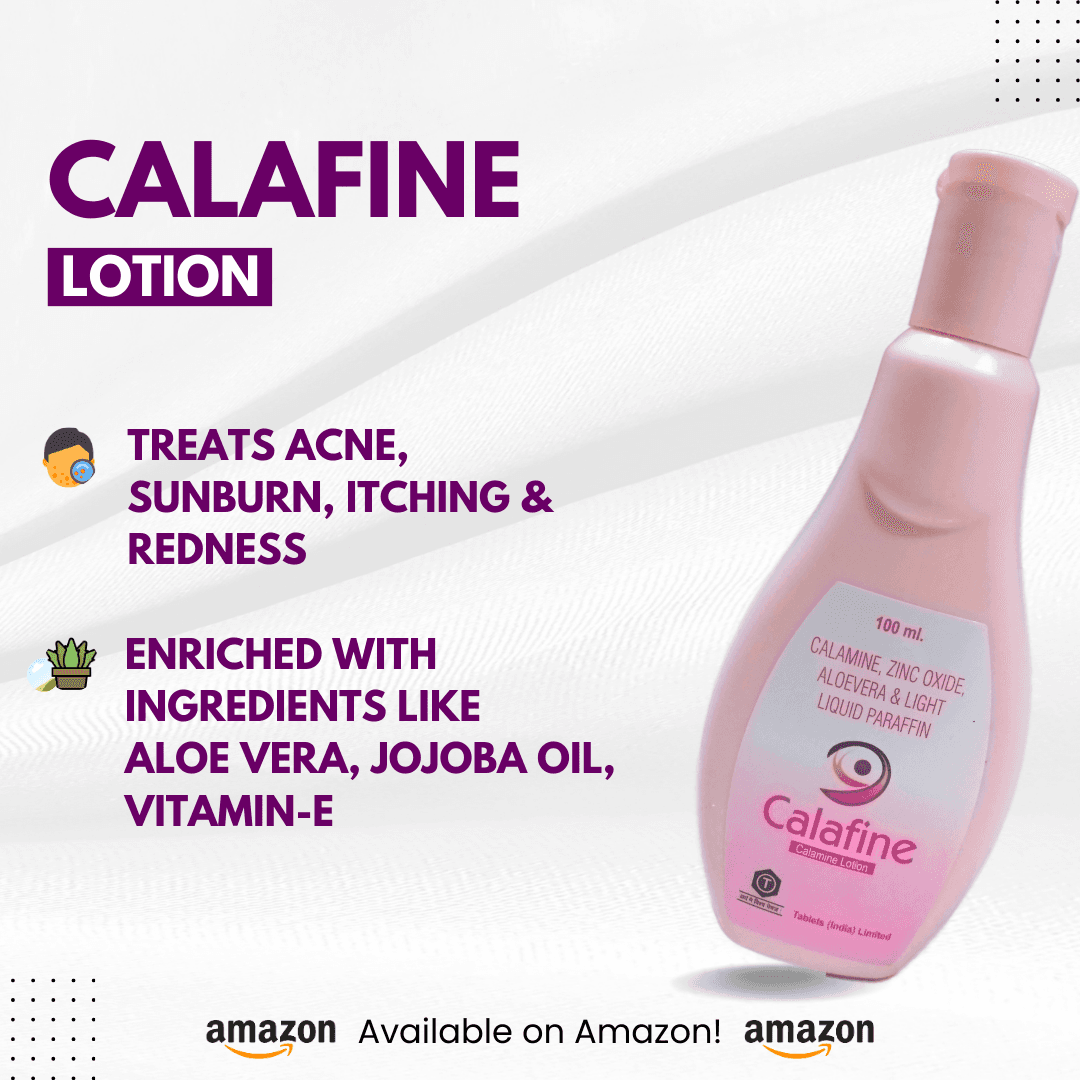
CALAFINE Lotion gives you all the benefits of calamine — without the excessive dryness, chalky residue, or alcohol sting. Formulated for Indian skin and climate.
Get CALAFINE Lotion on Amazon — Advanced Formula →Zinc Oxide — The Anti-Inflammatory Powerhouse
Zinc oxide is the primary active ingredient in calamine lotion, typically comprising 98% or more of the active content. When applied to inflamed skin, zinc ions are released slowly over several hours. These ions interact with cell membrane proteins to downregulate the production of pro-inflammatory cytokines — the signalling molecules that cause redness, swelling, heat, and pain. This is not merely a surface cooling effect. Zinc oxide actually changes the inflammatory cascade at the cellular level. For conditions like sunburn, where UV radiation has triggered a massive inflammatory response in the dermis, calamine application within the first few hours can meaningfully reduce the depth and duration of tissue damage. The visible result is less peeling, less long-term pigmentation, and faster return to normal skin function.
Beyond inflammation, zinc oxide also provides physical UV protection. While calamine lotion is not a substitute for sunscreen (typical SPF is around 3-5, inadequate for Indian sun exposure), it does offer some protection against incidental UV exposure during indoor use. The opaque, reflective nature of zinc oxide particles means that a visible layer of calamine reflects both UVA and UVB radiation away from the skin surface — a useful secondary benefit for those using calamine daily.
The Cooling Effect — Immediate Symptom Relief
Calamine lotion works through a mechanism that is both chemical and physical. The water content in the lotion evaporates from the skin surface at a controlled rate, carrying heat away from the inflamed tissues below. This evaporative cooling is why calamine feels immediately soothing when applied to hot, sunburned, or itchy skin — the sensation is not psychological, it is thermodynamics. The cooling effect is particularly valuable for heat-related skin conditions like prickly heat, where the primary symptom is an unpleasant sensation of heat trapped beneath the skin's surface. By accelerating evaporative heat loss, calamine restores the normal thermal balance of the outer epidermis, interrupting the cycle of sweat duct blockage that defines the condition.
However, there is a nuance here that many users miss. The cooling effect works best when calamine is applied in a thin, even layer. Thick, cakey application actually insulates the skin, trapping heat and reducing evaporative cooling. The correct application for heat rash or sunburn is a thin, almost translucent film — not the thick, opaque layer that many people associate with "proper" calamine use. More is not better; precise application is better.
Astringent Action — Drying Without Damage
Calamine's astringent properties come from its ability to precipitate surface proteins, causing a mild contraction of the outer skin layers. This has two important effects. First, it dries out weeping or oozing lesions — think poison ivy blisters, wet eczema, or infected insect bites — by coagulating the serum that leaks from damaged capillaries. Second, it creates a physical barrier over the affected area that reduces further moisture loss while simultaneously absorbing excess surface moisture. This dual action — absorbing moisture while sealing the area — is what makes calamine uniquely valuable for wet dermatological conditions. Most moisturizers add moisture. Most drying agents simply absorb moisture without creating a protective barrier. Calamine does both, which is why it remains the first-line recommendation for oozing contact dermatitis and similar conditions even in modern dermatology.
For acne-prone skin, this astringent action translates into reduced surface oil without the harsh stripping effect of alcohol-based toners. Alcohol destroys the skin's acid mantle and triggers compensatory oil production. Calamine absorbs surface oil without disrupting the underlying barrier function, which means less shine without the rebound greasiness that alcohol products cause. This makes calamine a genuinely superior choice for daily oil control compared to the astringents sold in most skincare aisles.
The CALAFINE Difference — Beyond Traditional Calamine
Traditional calamine lotion has limitations. Its drying effect can be excessive for normal or combination skin. It provides no hydration, no skin barrier repair, and no additional active ingredients for complex skin concerns like acne marks or uneven texture. This is where CALAFINE Lotion represents a meaningful formulation upgrade. CALAFINE retains the core benefits of calamine — zinc oxide for inflammation, cooling for heat relief, astringent action for oil and moisture control — but adds skin-nourishing ingredients that make daily use practical for a much wider range of skin types. The inclusion of moisturizing bases means that CALAFINE does not dry out normal or combination skin with repeated use. You get the soothing, oil-absorbing benefits of calamine without the tight, parched feeling that pure calamine leaves behind after a few days of application.
The formulation also addresses the cosmetic issue that prevents many people from using calamine daily: the visible white cast. Traditional calamine leaves a chalky, opaque residue that is socially difficult to wear during daytime hours. CALAFINE's micronized particles and improved base spread more evenly and absorb more completely, leaving minimal visible residue after proper application. This means you can use it in the morning before work or school without looking like you are wearing a visible treatment product — a practical improvement that dramatically increases real-world daily use compliance.
Step-by-Step Daily Application Guide
Correct application technique is the difference between effective daily use and skin problems. Follow this protocol exactly.
Cleanse the Area Gently
Wash the skin with a mild, sulphate-free cleanser and lukewarm water. Do not use hot water, which will worsen inflammation. Pat dry with a soft towel — do not rub, as friction aggravates most conditions calamine treats.
Shake the Bottle Thoroughly
Calamine lotion settles over time. Shake vigorously for at least 10 seconds until the liquid is completely uniform in colour and consistency. Failure to shake properly results in uneven application — too much powder in some spots, too much liquid in others.
Apply a Thin, Even Layer
Dispense a small amount onto a cotton pad or clean fingertips. Apply in a thin, even film over the affected area. The correct thickness is enough to see a slight colour change on the skin, but not so thick that it feels cakey or cracks when you move. Thicker is not better — it reduces evaporative cooling and increases residue.
Allow to Dry Completely
Wait 2-3 minutes for the lotion to dry to a powder-like finish. Do not cover with clothing or bandages until fully dry, as this will wipe off the active layer. For facial application, this is the time to assess whether the residue is acceptable for daytime wear.
Reapply as Needed (Maximum 3-4 Times Daily)
Calamine's effects last 3-4 hours on most skin types. For ongoing conditions like heat rash or sunburn, reapply as needed. Do not exceed four applications in 24 hours, as over-application can lead to excessive dryness and barrier disruption even in oily skin types.
Moisturize Dry Areas Separately
If you have combination or normal skin and are applying calamine to the whole face, apply a lightweight, non-comedogenic moisturizer to the drier areas (cheeks, around the mouth) after the calamine has dried completely. Do not mix them — layer moisturizer over dry calamine.
What to Expect When Using Calamine Daily
Daily calamine use produces different effects at different timescales. Here is an honest timeline of what you will experience, assuming you are using an appropriate formulation for your skin type.
The evaporative cooling effect begins working immediately upon application. For sunburn, heat rash, and insect bites, you should feel noticeable relief within 30-60 seconds. Redness begins to subside within 5-10 minutes as the zinc oxide anti-inflammatory action takes effect.
With twice-daily application, most inflammatory skin conditions show significant improvement within the first 72 hours. Sunburn redness fades to pink then normal skin tone. Heat rash bumps flatten. Insect bite swelling decreases noticeably. For acne, individual spots become less red and painful.
For daily use on oily skin, the oil-absorbing effects become most noticeable after 5-7 days of consistent application. Shine throughout the day reduces by approximately 40-60% compared to no treatment. New acne breakouts should decrease in frequency as surface oil — which feeds acne bacteria — is consistently managed.
By week three of daily use, your skin will have fully adapted to the calamine routine. For oily skin types, sebum production may actually downregulate slightly as the skin no longer needs to compensate for surface oil being stripped. For normal or combination skin using calamine only on oily zones, this is when you will know whether daily use is sustainable or if you need to reduce frequency.
How to Choose a Calamine Lotion in India — Complete Buying Guide
Not all calamine lotions are equal. The Indian market is flooded with products making similar claims but containing vastly different formulations. Here is what to look for — and what to avoid.
Common Mistakes People Make When Buying Calamine in India
The most common buying mistake is assuming all calamine lotions are identical and choosing purely on price. Budget calamine lotions often contain significant amounts of alcohol (listed as SD alcohol, denatured alcohol, or simply "alcohol" in the ingredients) as a preservative and to speed drying. Alcohol stings on broken skin, over-dries even oily skin with repeated use, and disrupts the skin barrier over time. For daily use, alcohol-free formulations are non-negotiable.
The second most common mistake is ignoring the base formulation. Traditional calamine lotion has a water base that dries to a powdery, chalky residue. This is fine for body application at night but problematic for facial use or daytime wear. Modern formulations like CALAFINE use cream or gel bases that spread more evenly, absorb more completely, and leave minimal visible residue. If you plan to use calamine during the day or on your face, the modern base is worth the additional cost.
The third mistake is buying a bottle that is too small for your intended use pattern. If you plan to use calamine daily on your face or large areas of your body, a 100ml bottle will last approximately 2-3 weeks. Buying a pack of two or a larger bottle ensures you do not run out mid-routine — interrupted consistency produces worse results than the same total applications spread across gaps.
The right calamine for daily use. The right formulation for your skin.
CALAFINE Lotion — alcohol-free, non-drying, micronized for minimal residue.
Shop CALAFINE Lotion on Amazon →Who Benefits Most From Daily Calamine Use
Outdoor Workers in Indian Summers
Daily sun exposure — whether construction, delivery, or agriculture — causes cumulative sun damage. Daily calamine use soothes the low-grade inflammation that would otherwise accelerate photoaging.
Runners and Outdoor Exercisers
Sweating during exercise in India's heat frequently triggers heat rash on the chest, back, and inner arms. Post-workout calamine application prevents the sweat duct blockage that causes prickly heat.
Women With Oily, Acne-Prone Skin
Daily calamine use as a mattifying treatment reduces shine, prevents the clogged pores that cause comedonal acne, and soothes existing breakouts without the irritation of chemical acne treatments.
Parents of Infants and Toddlers
Diaper rash, drool rash, and heat rash are daily battles in Indian childcare. Calamine lotion at each diaper change prevents and treats all three without the petroleum greasiness of traditional diaper creams.
Urban Residents in High-Pollution Cities
Delhi, Mumbai, Kolkata, and Bengaluru's air pollution lands on skin as particulate matter that triggers inflammatory responses. Daily calamine provides a physical barrier and soothes pollution-induced irritation.
People Prone to Contact Dermatitis
If you react to plants, detergents, or cosmetics with red, itchy, weeping patches, calamine is your first-line treatment. Daily use during flare-ups controls symptoms without the side effects of topical steroids.
Post-Laser or Post-Peel Patients
After dermatological procedures, skin is red, sensitive, and prone to heat sensation. Calamine's cooling and anti-inflammatory effects make it an excellent post-procedure soother — with dermatologist approval.
Anyone Living in High-Mosquito Areas
In mosquito-dense regions, daily calamine use on exposed skin both treats existing bites and may reduce the itch response to future bites through its mild antihistamine effect at the skin surface.
Calamine Myths vs. Truth — What Indian Consumers Get Wrong
Calamine lotion is only for children — adults should use stronger products
Calamine's efficacy is not age-dependent. Its anti-inflammatory, cooling, and astringent effects work equally well on adult and child skin. In fact, many adult skin conditions — particularly those involving inflammation and moisture imbalance — respond better to calamine than to harsh chemical treatments.
If a little calamine works, a thick layer works better
Thick application reduces evaporative cooling, traps heat against the skin, and creates a cracking, flaking mess that provides no additional benefit. The correct application is a thin, even film. More product does not mean more effect — it means more waste and worse results.
Calamine is a moisturizer — it hydrates dry skin
Calamine contains no moisturizing ingredients in its traditional formulation. It is a drying, astringent agent. Applying calamine to dry skin without accompanying moisturizer will make the dryness significantly worse over time. This misconception causes more calamine-related skin problems than any other.
Calamine cures acne — it makes pimples disappear overnight
Calamine reduces inflammation and absorbs surface oil, which helps existing pimples look less red and angry. It does not kill acne bacteria, unclog deep pores, or prevent new breakouts on its own. For acne treatment, calamine is a supportive therapy, not a standalone cure. Use it alongside salicylic acid or benzoyl peroxide for best results.
All calamine lotions are exactly the same — just buy the cheapest one
Formulations vary dramatically in alcohol content, base ingredients, particle size, and additional active ingredients. Cheap calamine lotions often contain high alcohol percentages that sting and over-dry. Premium formulations like CALAFINE use better bases, smaller particles for less residue, and added skin-nourishing ingredients that make daily use practical.
You cannot use calamine on your face — it will clog pores
Calamine is non-comedogenic (does not clog pores) when properly formulated. The zinc oxide particles are too large to penetrate the pore opening, and the base ingredients in quality formulations are chosen to avoid pore blockage. The white residue is a cosmetic issue, not a pore-clogging one. Many dermatologists recommend calamine specifically for facial acne and oil control.
Frequently Asked Questions About Daily Calamine Use
Can I use calamine lotion on my face every day?
Yes, but only if you have oily or acne-prone skin. Daily facial use on normal or dry skin will cause excessive dryness, tightness, and potential barrier disruption. If you have oily skin, apply a thin layer to the T-zone daily. If you have combination skin, apply only to the oily areas and moisturize the dry areas separately. For dry or mature skin, limit facial use to occasional spot treatment only.
Is calamine lotion safe for daily use during pregnancy?
Calamine lotion is generally considered safe for topical use during pregnancy. The active ingredients (zinc oxide and ferric oxide) are not significantly absorbed through the skin into the bloodstream. Many dermatologists recommend calamine as a first-line treatment for pregnancy-related skin issues like heat rash and itchiness because it avoids the systemic absorption concerns of other medications. However, as with any product during pregnancy, consult your obstetrician before beginning daily use.
Can I use calamine lotion and moisturizer together?
Yes, and for anyone with normal or combination skin using calamine daily, you absolutely should. Apply calamine first, allow it to dry completely (2-3 minutes), then apply a lightweight, non-comedogenic moisturizer over it. Do not mix them together before application, as this will alter the drying and astringent properties of the calamine. Layering them separately preserves each product's intended function.
How many times per day can I safely apply calamine lotion?
For most skin conditions, 2-3 applications per day is optimal. Do not exceed four applications in 24 hours. Over-application leads to excessive dryness, potential barrier disruption, and diminishing returns — the skin can only absorb or benefit from so much zinc oxide before the excess simply sits on the surface as an ineffective, cakey layer.
Will calamine lotion dry out my skin if I use it daily?
Yes, if you use traditional calamine on normal or dry skin without accompanying moisturizer. The traditional formulation is inherently drying — that is part of its mechanism for oily skin and weeping lesions. If you have oily skin, the drying effect is therapeutic. If you have normal or dry skin, daily calamine use requires a companion moisturizer. CALAFINE and similar modern formulations reduce this drying effect through added moisturizing bases.
Can men use calamine lotion daily as an aftershave treatment?
Yes, and it works well for this purpose. Calamine's anti-inflammatory properties soothe razor burn and reduce the redness from shaving irritation. Its astringent action closes pores and reduces the risk of ingrown hairs. Apply a thin layer to shaved areas immediately after shaving, allow to dry, then apply a moisturizer. Many men find this routine more effective than commercial aftershave products, which often contain alcohol that stings and dries.
Is calamine lotion safe to use with other skincare products like retinol or vitamin C?
Use caution. Calamine should be applied to clean, dry skin before other products. Do not layer calamine directly over retinol or vitamin C, as the pH differences may reduce efficacy. The safest approach is to use calamine in the morning (for oil control and daytime soothing) and retinol or vitamin C at night. If you must use them together, apply your treatment serum first, wait 10 minutes, then apply calamine only to areas not covered by the serum.
Does calamine lotion expire? How long can I keep using the same bottle?
Calamine lotion typically expires 2-3 years from the manufacturing date. Check the expiry date on the bottle. Using expired calamine is not dangerous (the active ingredients remain stable for years), but the suspension may separate irreversibly, making even vigorous shaking unable to recombine the powder and liquid properly. This results in uneven application — too much powder in some spots, too much liquid in others. Replace any bottle where the lotion no longer forms a uniform suspension after shaking.
Can I use calamine lotion on my scalp for dandruff or itching?
Yes, but application is messy. Calamine's anti-inflammatory and drying effects can help with an itchy, irritated scalp, particularly if the itching is caused by heat or mild seborrheic dermatitis. Part the hair to expose the scalp, apply a thin layer directly to the affected areas, and allow to dry before styling. The white residue will be visible on dark hair, so night-time application before washing is more practical. For chronic dandruff, medicated shampoos are more effective than calamine.
What is the difference between calamine lotion and CALAFINE Lotion?
Traditional calamine lotion is a simple suspension of zinc oxide and ferric oxide in water with a suspending agent. It is effective but drying, leaves significant white residue, and contains no skin-nourishing ingredients. CALAFINE Lotion is a modern formulation that retains the active benefits of calamine — zinc oxide for inflammation, cooling effect, astringent action — but adds moisturizing bases and skin-repairing ingredients that make daily use practical for normal and combination skin types. It also uses micronized particles for less visible residue and better absorption. For daily use, particularly on the face, CALAFINE is the superior choice.
Daily Calamine — Right Formula, Right Application, Right Results
Calamine lotion is safe for daily use — for the right skin types, with the right formulation, applied correctly. If you have oily or acne-prone skin, daily calamine use can transform your skin by controlling oil, reducing inflammation, and preventing breakouts. If you have normal or combination skin, you can use it daily on your oily zones while moisturizing the rest. If you have dry or mature skin, limit use to occasional spot treatment.
CALAFINE Lotion is the modern formulation designed for daily use. Alcohol-free, non-drying, with moisturizing bases and micronized particles for minimal residue. It gives you all the benefits of traditional calamine without the drawbacks that make daily use problematic.
Buy CALAFINE Lotion on Amazon →Pack of 2 · Alcohol-Free · All Skin Types · Free Delivery Available